How to Shop Online Without Getting Manipulated: The Complete Guide
By The Ask Shopi Team · 11 min read
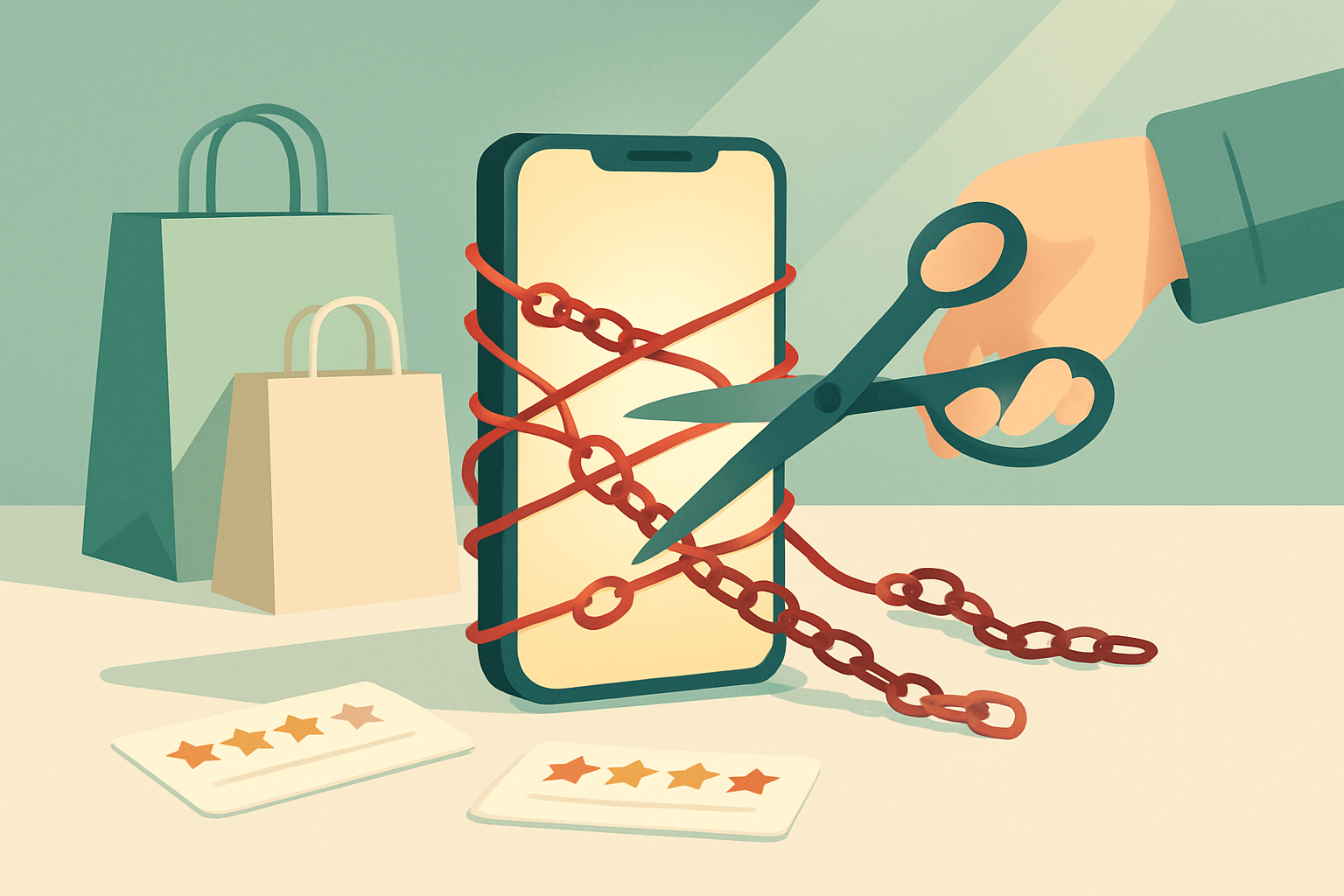
Learning how to shop online well in 2026 is no longer mostly about finding the lowest price. The harder skill is figuring out who actually profits from the advice you read on the way to checkout. Most "best of" articles, review videos, comparison sites, and even some AI shopping assistants earn money when you click and buy — which means the recommendation you trust may have been quietly shaped by a commission you never see. None of that makes the advice worthless. But it does mean you need a method. This guide is a vendor-neutral map of how to shop online with your eyes open: how shopping advice gets funded, how to research and compare, how to spot fake reviews and dark patterns, what the rise of AI shopping changes, and how to choose tools that are genuinely on your side.
A quick note on tone before we start: the goal here is not to convince you that everyone is lying. They aren't. Plenty of reviewers do careful, good-faith work. The honest framing is simpler and more useful — incentives shape recommendations. Once you can see the incentives, you can read any source clearly, including this one.
Why learning how to shop online starts with following the money
Almost no shopping advice is truly free, because someone has to pay for the testing, writing, and hosting. Understanding who pays is the single most powerful shopping skill you can build.
The dominant model is affiliate marketing: a publisher links to a retailer, and if you buy, the publisher earns a percentage. This funds real work. Wirecutter, for example, is a genuinely rigorous, good-faith publication that runs hands-on testing — and it earns roughly 6–10% per sale through affiliate links. That commission pays for labs and editors, and the model is perfectly legitimate. The catch isn't the existence of money; it's that a product paying a higher commission, or one that's in stock at a partner retailer, carries a structural advantage before its merits are even weighed.
AI tools are now adopting the same playbook. When OpenAI launched Instant Checkout inside ChatGPT in November 2025, it confirmed that merchants pay roughly a 4% fee on completed purchases. That's a reasonable business — but it means an "AI recommendation" can sit on top of a transaction fee, just like an affiliate link sits on top of a click.
The short taxonomy of who pays
- Affiliate commissions — the site earns a cut of your purchase.
- Display ads and sponsorships — brands pay for visibility, sometimes for placement.
- Retail media — marketplaces sell ad slots inside their own search results.
- Data brokerage — your behavior is the product, sold or rented to advertisers.
- Subscriptions — you pay directly, so the tool answers to you instead of a merchant.
For a deeper breakdown of how commissions tilt the rankings you read, see how affiliate commissions shape recommendations. And if you're specifically weighing AI tools, who pays for AI shopping picks walks through the same question for chatbots and assistants.
How to research and compare products before you shop online
Once you accept that incentives are everywhere, research becomes a process of separating the claim from the interest behind it. A few habits do most of the work.
Triangulate sources. Never rely on a single article or a single star rating. Read at least one affiliate-funded review, one independent owner forum or subreddit, and one source that has no obvious financial stake. Where they agree, you've found something solid.
Read against the grain. Sort reviews by lowest rating first. The one-star reviews tell you the failure modes; the five-star reviews tell you the marketing. The truth is usually the boring middle.
Check the methodology, not just the verdict. A trustworthy recommendation explains how it was tested and why the winner won. If a page only tells you what to buy and where to buy it, treat it as an advertisement until proven otherwise.
Separate the spec sheet from the experience. Specs are easy to compare and easy to game. Look for durability, support quality, and how the product holds up after six months — details that affiliate pages rarely emphasize because they don't drive a fast click.
A practical pre-purchase checklist:
- Define your actual need in one sentence before reading any reviews.
- Find three independent sources and note where they disagree.
- Read the worst reviews first, then the best.
- Confirm the price across at least two retailers.
- Wait 24 hours on anything non-urgent — urgency is usually manufactured.
When you want a longer reference on separating genuine evaluations from paid placement, finding honest reviews despite affiliate links covers it in depth.
"Best of" lists: useful, but read the fine print
"Best [product] of 2026" pages are the workhorses of online shopping — and they're worth using, as long as you read them critically. They're convenient, often well-researched, and frequently funded by the links inside them.
We ran a small audit to put numbers on this. In a sample of 43 "best of" pages, roughly 81% carried affiliate tracking links. That figure isn't an accusation — affiliate funding can absolutely coexist with honest testing. But it does mean the ranking order deserves scrutiny, because the difference between the #1 and #3 pick can be the difference between a high-commission product and a low one.
What to check on any "best of" list:
- Disclosure. Is the affiliate relationship stated clearly, near the top, not buried in a footer?
- Testing evidence. Photos, measurements, time spent — or just stock images and spec tables?
- Freshness. When was it last updated? Stale "best of" lists often point to discontinued or superseded models.
- Link behavior. Does every product link route through a tracker, or are some neutral?
If you'd rather sidestep the commission-tilted ranking problem entirely, here's an unbiased alternative to "best of" review sites and how it differs structurally.
How to spot fake reviews and dark patterns
Reviews are the backbone of online trust, which makes them a prime target for manipulation. Research from the University of South Florida suggests that about a third of online reviews may be unreliable or fake. Regulators have noticed: in 2024 the FTC formally banned fake and incentivized reviews, with penalties for buying, selling, or faking them. Enforcement helps, but you still need to defend yourself in the moment.
Fast tells that a review may be fake or coached:
- A burst of five-star reviews all posted within a few days.
- Generic praise that never names a specific feature ("Great product, highly recommend!").
- Reviewers with no other review history, or histories full of unrelated five-star raves.
- Repeated phrasing across multiple reviews — a sign of templated or paid content.
- Mismatch between the glowing rating and the lukewarm written content.
Dark patterns are the other half of the manipulation toolkit — design tricks that nudge you toward a worse decision:
- Manufactured scarcity ("Only 2 left!") and countdown timers that reset on refresh.
- Drip pricing, where fees appear only at the final checkout step.
- Confirmshaming ("No thanks, I don't want to save money").
- Pre-checked boxes for warranties, subscriptions, or insurance.
- Social-proof theater ("23 people are viewing this right now").
When you're staring at a single product page and need a verdict fast, this guide to vetting a review in 60 seconds gives you a repeatable drill.
The rise of AI shopping — and the trust gap
AI assistants are quickly becoming a default way to research purchases, and the adoption numbers are real. Capital One Shopping reports that around 56% of shoppers used generative-AI tools while shopping during the 2025 holiday season. Curiosity is high.
Trust, however, is not keeping pace. A 2025 YouGov survey found that about 43% of people are aware of AI shopping assistants, only ~14% have actually used one, and just ~46% say they would "fully trust" its recommendations. That space between I'll try it and I believe it is the defining feature of AI shopping right now — and it exists for a good reason. We explore why in the AI shopping trust gap.
The most important question to ask an AI assistant is not "how smart is it?" but "how does it make money?" An assistant funded by transaction fees, retail media, or data has a built-in reason to nudge — no matter how natural its language sounds. To weigh assistants by their underlying economics rather than their chat polish, see AI assistants compared by business model. And for a practical decision framework, here's how to choose the best AI shopping assistant.
Personalization vs. targeting: are you the customer or the product?
"Personalized" is one of the most abused words in online retail, because it describes two opposite things.
Personalization uses what you've told a tool — your needs, budget, constraints, and preferences — to serve you a better answer. The relationship runs in your favor.
Targeting uses what's been collected about you — your browsing, location, and purchase history — to serve advertisers a better outcome. The relationship runs in their favor, and you're often the product being sold.
The two can look identical on screen. The way to tell them apart is to ask three questions: Is my data sold or shared? Do paid placements change what I'm shown? Can I see the reasoning behind a recommendation? If you can't get clear answers, assume targeting. For a full breakdown of the distinction and what it means for your privacy, read personalization vs. targeting.
How to choose shopping tools that are actually on your side
Pull the threads together and a simple test for any shopping tool emerges. Run every recommender — human, list, or AI — through these five filters:
- Follow the money. Does it earn from your purchase (commission, ads, fees) or from your subscription? Direct payment aligns incentives with you.
- Demand transparency. Can it tell you why a product is being recommended — ideally with an explicit relevance score, not just a confident sentence?
- Check the outbound links. Are they neutral, or wrapped in affiliate trackers? Neutral links signal there's no commission steering the pick.
- Protect your data dignity. Is your information sold or rented? A tool that profits from your data has a conflict baked in.
- Keep an escape hatch. Can you easily verify a claim elsewhere, or does the tool try to close the loop and keep you inside its checkout?
For transparency about where this guide comes from: Shopi is built to pass its own test. It earns nothing when you buy — zero affiliate links, no ads, no commissions — and it never sells your data. Every recommendation comes with a plain-language "why this is for you" plus a relevance score, and outbound links go straight to the product page, not tracked affiliate URLs. Revenue comes from optional subscriptions only: a free tier at $0 with 10 searches a month, and Premium at $3.99/month or $29.99/year. You can also try a no-signup demo, though it runs on a sample profile and isn't tailored to you — it just shows the mechanics. The full reasoning lives on why we're different. Mention this not because it's the only honest option — good-faith reviewers and well-run affiliate sites exist — but because you should always know who's talking and how they get paid.
A repeatable checklist for how to shop online with your eyes open
You don't need to memorize this whole guide. You need a routine you can run in a few minutes:
- Name your need in one sentence before reading anything.
- Ask who pays for every source you consult.
- Triangulate across an affiliate review, an independent community, and a neutral source.
- Read the worst reviews first, and watch for fake-review tells.
- Spot the dark patterns — fake scarcity, drip pricing, pre-checked boxes — and refuse to be rushed.
- For AI tools, ask how they make money before you trust the pick.
- Confirm the price across at least two retailers.
- Sleep on it for anything non-urgent.
Do this consistently and the manipulation loses most of its power. The market doesn't have to be adversarial — it just helps to know the rules of the game you're already playing.
If this way of shopping resonates, you're welcome to try a tool built around it. Shopi gives you honest, unbiased recommendations with a transparent reason for every pick — and you can start free at the home page with no card required. If it's not for you, that's fine too; take the checklist above and use it anywhere. The point was never to sell you something. It's to make sure that whatever you buy, you bought it with your eyes open.
Frequently asked questions
Is it bad if a review site uses affiliate links?
Not inherently. Affiliate commissions fund real testing, and respected publications like Wirecutter do rigorous, good-faith work while earning roughly 6 to 10 percent per sale. The issue is that commissions can quietly shape ranking order, so a higher-paying product gets a structural edge. Treat affiliate-funded lists as useful but check the disclosure, testing methodology, and whether every link is a tracker.
How can I tell if an online review is fake?
Watch for bursts of five-star reviews posted within a few days, generic praise that never names a specific feature, reviewers with thin or all-five-star histories, and repeated phrasing across multiple reviews. Research suggests about a third of online reviews may be unreliable, and the FTC banned fake and incentivized reviews in 2024. Sorting by the lowest ratings first usually reveals a product's real weaknesses.
Are AI shopping assistants trustworthy?
Adoption is rising fast, with around 56 percent of shoppers using generative-AI tools during the 2025 holidays, but trust lags behind. A 2025 YouGov survey found only about 46 percent say they would fully trust an assistant's recommendations. The deciding factor is the business model: ask how the assistant makes money. Transaction fees, ads, or data sales create incentives to nudge, regardless of how natural the chat feels.
What's the difference between personalization and targeting?
Personalization uses what you tell a tool, such as your needs and budget, to serve you a better answer. Targeting uses data collected about you, like browsing and purchase history, to serve advertisers, often making you the product being sold. They can look identical on screen, so ask whether your data is sold, whether paid placements change results, and whether you can see the reasoning behind a recommendation.
How does Shopi make money if it has no ads or affiliate links?
Shopi earns revenue only from optional subscriptions: a free tier with 10 searches a month, and Premium at $3.99 per month or $29.99 per year. It carries zero affiliate links, ads, or commissions, earns nothing when you buy, never sells your data, and links you directly to the product's page. Because you are the customer rather than the product, its incentives stay aligned with finding you the right item.
Sources
- YouGov: AI shopping assistants are catching on but shoppers still need convincing (2025)
- Capital One Shopping: AI shopping statistics (2025)
- OpenAI: Buy it in ChatGPT / Instant Checkout merchant fee (Nov 2025)
- Ahrefs: Wirecutter SEO case study (affiliate commission per sale)
- University of South Florida: Fake online reviews study (2025)
- FTC: Endorsements, influencers, and reviews guidance (2024 rule)