How to Choose an Air Conditioner
By The Ask Shopi Team · 7 min read
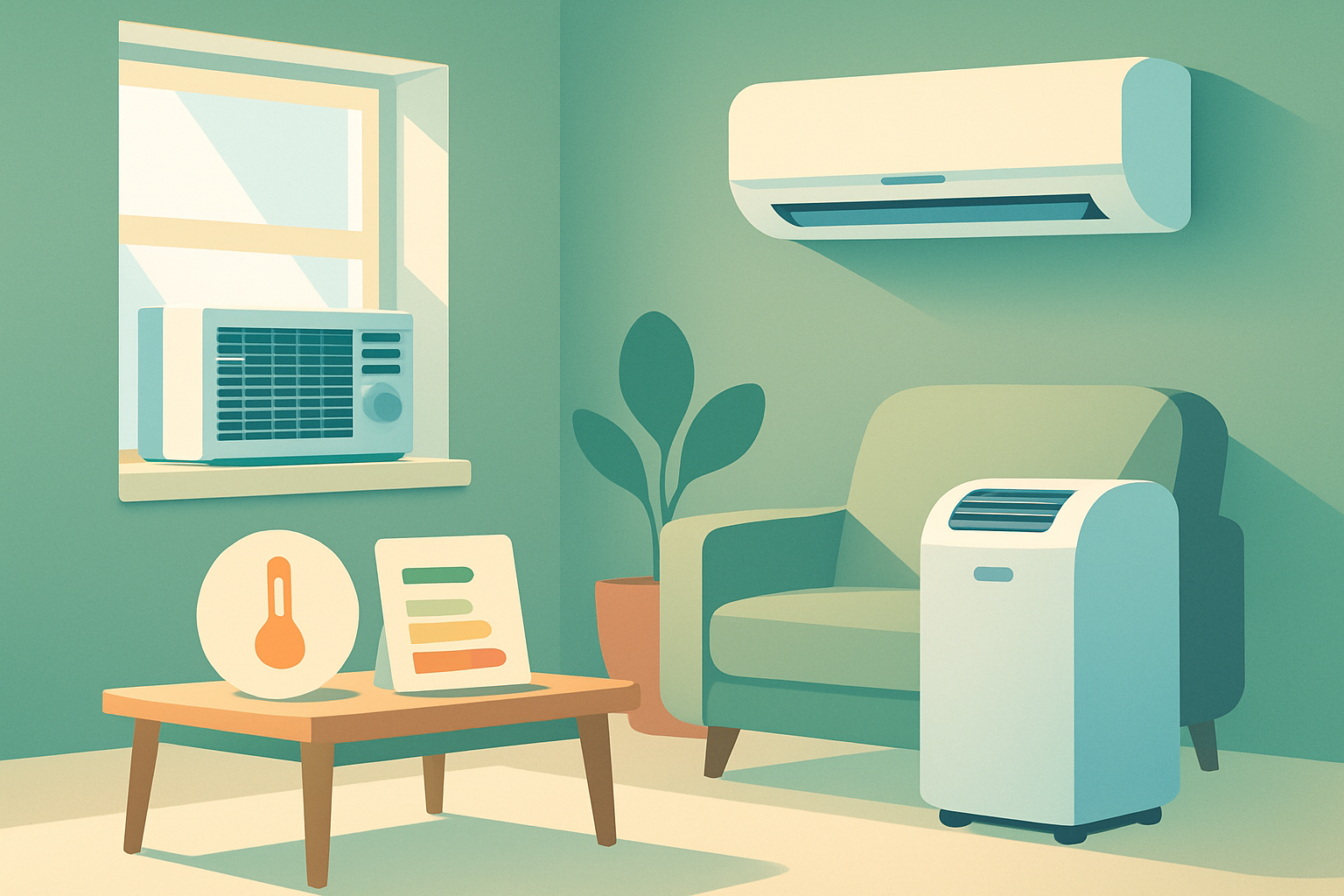
Figuring out how to choose an air conditioner gets complicated fast, because "air conditioner" isn't one product. It's at least three (window, portable, and ductless mini-split), each with its own install, noise, and cost story. Layer on a spec sheet full of BTUs, EER2, and CEER, and it's easy to fixate on the biggest number and walk away with a unit that's too loud, can't legally go in your window, or, counterintuitively, cools the room while leaving it clammy.
The good news: a handful of questions settle most of the decision. What type fits your home and whether you rent or own, how big the room is, what it costs to run, how loud it is, and what your lease and your outlet will actually allow. This guide walks through each one in plain language, with no brand names and no affiliate links, so you can judge any unit on its own merits.
Pick your type before anything else
Three formats cover almost everything, and they sort neatly by how permanent the setup is and whether you own the place.
- Window units are the inexpensive, install-it-yourself default. They sit in a window opening (usually a double-hung frame), so confirm your window type and size are compatible. The catch: they block the window and the view, and they need a frame that fits.
- Portable units roll from room to room and vent hot air out a window through a hose kit. They're the go-to when a window unit won't fit your window or your lease forbids one, and they suit renters who move often. The trade-off is that the compressor sits inside the room, so they tend to be the loudest of the three and they take up floor space.
- Ductless mini-splits are the most efficient and quietest option. The indoor head is essentially just a fan, while the compressor lives outside. But they require professional installation and a permanent hole through your wall, which makes them a fit for owners far more than renters.
Decide based on three things: how permanent you want the setup to be, whether you own or rent, and whether you're cooling one room or several. That single choice rules out most of the catalog before you compare a single spec.
One expectation to set up front: an air conditioner cools and dehumidifies, but it doesn't clean your air. For dust, pollen, or wildfire smoke, you're looking at a separate appliance (our guide to choosing an air purifier covers that). And if the same room turns cold in winter, a space heater tackles the opposite problem, though some mini-splits handle both heating and cooling.
Size is the spec that makes or breaks it
This is the one to get right, and the instinct to "buy big to be safe" is exactly the trap. Cooling capacity is measured in BTU (British thermal units) per hour.
The U.S. Department of Energy publishes a general rule of thumb of roughly 20 BTU per square foot of living space: multiply the room's length by width, then by about 20. ENERGY STAR offers an equivalent approach, where you measure the room's square footage and look up the recommended capacity on its published chart. Treat these as a starting point rather than gospel, and confirm the exact figure against the current DOE or ENERGY STAR chart for your specific room instead of a number you half-remember.
Here's the counterintuitive part both sources stress: bigger is not better. An oversized AC cools the air fast, then shuts off before it has run long enough to pull moisture out, leaving the room cold but damp and clammy, while the short-cycling wastes energy. A right-sized unit runs longer, dehumidifies properly, and simply feels more comfortable.
ENERGY STAR also lists widely published adjustments to refine the estimate: reduce capacity by about 10% for a heavily shaded room, increase it about 10% for a very sunny one, add roughly 600 BTU for each regular occupant beyond two, add about 4,000 BTU for a kitchen, and round down to the nearest 1,000 BTU. Beyond floor area, factor in ceiling height, your climate, insulation, and the size and quality of your windows. The goal is the right number for your room, not the biggest one on the shelf.
What it costs to run all summer
Two units with the same BTU rating can cost very different amounts to run. Room AC efficiency is expressed as EER or EER2 (and CEER, the Combined Energy Efficiency Ratio, which also accounts for standby power). Higher numbers mean less electricity for the same cooling, and if the unit will run for long stretches in peak summer, that gap compounds across the season.
The ENERGY STAR label is a quick shorthand: it signals the model meets the EPA's efficiency requirements. It's worth weighing against price, especially for a unit you'll run daily, because the cheaper sticker can quietly be the more expensive choice once the electric bill arrives.
Noise, and where the compressor lives
Noise comes down largely to where the compressor sits. Window units, and especially portables, keep the compressor inside the room, so they're typically louder. A mini-split's indoor head is just a fan, which is why it's the quietest of the three. If the AC is destined for a bedroom or a home office, compare published decibel (dB) ratings rather than trusting "quiet operation" on the box, and look at models with variable-speed (inverter) compressors, which can run gently at low output instead of cycling between full blast and off.
Installation, venting, and the fine print
This is where a unit that looks great on paper can fall apart in practice.
- Permission and fit. Before buying, confirm what your lease, building, or HOA actually allows. Some prohibit window units outright. Then measure your window type and dimensions. Window and portable units are DIY; a mini-split needs a professional and a wall penetration.
- Venting (portable units). A portable AC must vent hot air out a window through a hose kit. Single-hose designs are simpler but pull warm replacement air back into the room; dual-hose designs hold room pressure better.
- Drainage and condensate. Many portables self-evaporate moisture but may need a drain line in very humid climates. A window unit must be mounted level so condensate drains outside rather than leaking onto your floor.
- Electrical. Most smaller room units run on a standard 115V household outlet, but higher-BTU models can require 230/240V service or a dedicated circuit. Check your outlet, voltage, and plug type before you buy, or you'll end up with a unit you can't power.
Features worth weighing
The extras matter only if they match how you'll actually use the unit:
- A variable-speed (inverter) compressor for quieter, steadier, more efficient running.
- A programmable thermostat and timer so it isn't cooling an empty room.
- Easy-to-access, easy-to-clean filters, since a clogged filter quietly kills performance.
- Directional louvers that suit your room layout, so the air reaches where you sit.
- Optional smart/app or remote control, genuinely handy, but not a reason to overpay if the core specs aren't there.
Common mistakes to avoid
- Buying too big. The most common error is assuming more BTU means better cooling. Oversized units short-cycle, fail to dehumidify, and leave the room cold and clammy while wasting energy.
- Shopping on BTU and price alone. Skipping the EER2/CEER number and the ENERGY STAR label, which drive your running cost all season.
- Overlooking lease, HOA, and window constraints. Not checking whether window units are allowed, or whether your window actually fits the unit, before you pay.
- Skipping the venting and drainage plan. Forgetting a portable has to vent out a window, or mounting a window unit unlevel so it leaks indoors.
- Underestimating noise. Not comparing dB ratings for a bedroom or office, where an indoor compressor can be genuinely disruptive.
- Ignoring the electrical requirement. Assuming any outlet will do, when a high-capacity unit may need 230/240V or its own circuit.
Before you buy: a quick checklist
- Which type, window, portable, or mini-split, fits my home, my window, and whether I rent or own?
- What's the room's square footage, and what BTU does the DOE or ENERGY STAR rule put me at after adjustments?
- What's the EER2/CEER, and is it ENERGY STAR certified?
- How loud is it in decibels at the setting I'll actually use?
- Does my lease or HOA allow it, and does my outlet and voltage match?
- For a portable, what's the venting setup, and for a window unit, can I mount it level to drain?
Answer those and you can size up any air conditioner without leaning on a "best of" leaderboard.
Where Shopi fits in
Once you know your criteria, the search gets simple, and that's where a tool like Shopi helps, precisely because it has no stake in which unit you pick. It runs no affiliate links, no ads, and earns no commission when you buy, so nothing is quietly nudging you toward a pricier model. It learns your room, your budget, and the things you care about, explains every recommendation in plain language with a relevance score, and links you straight to the product's own page. You can try a no-signup demo to see how it works (it runs on a sample shopper profile, so results won't be tailored to you yet), then create a free profile in a couple of minutes for picks built around your room and your window. And if you're sorting through options more broadly, our guide to how to find the best product lays out a method that travels well beyond air conditioners.
Frequently asked questions
What size air conditioner do I need for my room?
Start with the general rule of thumb published by the U.S. Department of Energy: about 20 BTU per square foot, so multiply the room's length by width, then by roughly 20. ENERGY STAR offers an equivalent square-footage-to-capacity chart. Refine the estimate with ENERGY STAR's adjustments (about 10% less for a heavily shaded room, 10% more for a very sunny one, around 600 BTU per regular occupant beyond two, and about 4,000 BTU for a kitchen), then confirm the figure against the current chart. Crucially, don't round up to be safe: an oversized unit short-cycles and won't dehumidify well.
Why does a bigger BTU unit make the room cold but clammy?
An oversized AC cools the air to temperature quickly and then shuts off, before it has run long enough to pull humidity out of the room. You're left with air that's cold but damp, and the constant on-off cycling wastes energy. A right-sized unit runs longer and dehumidifies properly. Both the DOE and ENERGY STAR warn that bigger is not better for exactly this reason.
Window, portable, or mini-split, which should I get?
It depends on permanence and whether you own your home. Window units are inexpensive and DIY but block a (usually double-hung) window and need a compatible frame. Portables roll room to room and suit renters or windows a window unit won't fit, but they keep the compressor indoors so they're louder. Ductless mini-splits are the most efficient and quietest, but they need professional installation and a permanent wall penetration, which fits owners more than renters.
Can I plug any air conditioner into a normal outlet?
Not always. Most smaller room units run on a standard 115V household outlet, but higher-BTU models can require 230/240V service or a dedicated circuit. Check your outlet, voltage, and plug type before buying so you don't end up with a unit you can't power, and plug it directly into the wall rather than an extension cord or power strip.
Is an ENERGY STAR air conditioner worth it?
If the unit will run for long stretches in peak summer, usually yes. The label signals the model meets the EPA's efficiency requirements, and efficiency (expressed as EER2 or CEER) determines how much electricity it uses for the same amount of cooling. Two units with identical BTU ratings can cost very different amounts to run, so the cheaper sticker price can turn out to be the pricier choice over a full season.