How to Choose a Tower Fan
By The Ask Shopi Team · 7 min read
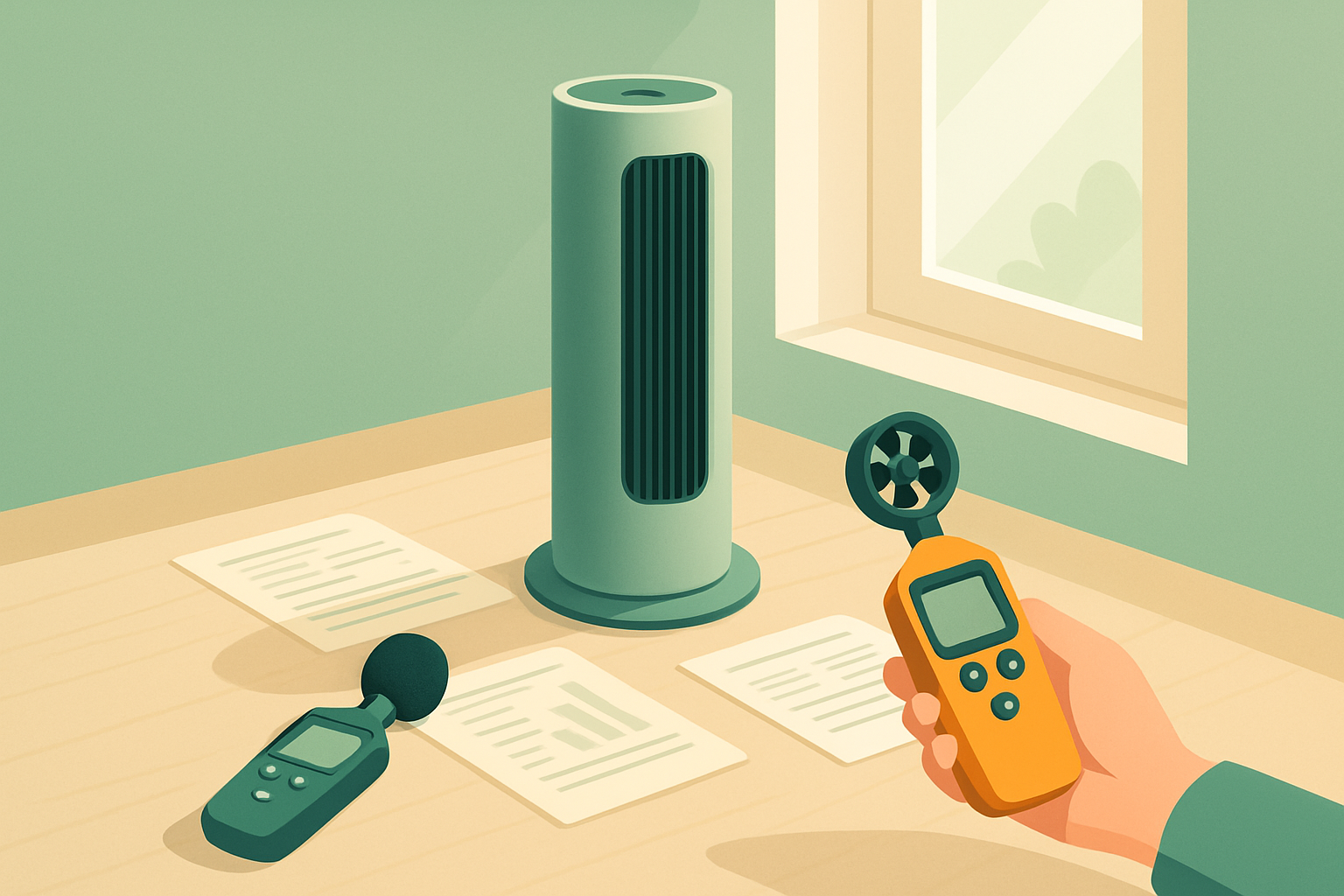
A tower fan is one of the easiest appliances to buy badly. It's slim, it tucks into a corner, and the box is covered in promises — "8 speeds," "turbo mode," "smart breeze" — none of which tell you the one thing that matters: how much air the thing actually moves, and whether it does that quietly enough for the room you have in mind. How to choose a tower fan really comes down to a handful of plain questions, and almost none of them are answered by the speed count on the front of the box.
It helps to start with what a fan does: it doesn't lower a room's temperature. As ENERGY STAR puts it, fans cool people, not rooms; the breeze pulls heat off your skin (a wind-chill effect) so you feel cooler while you're sitting in it. That one fact quietly decides most of the criteria below. Here's how to read past the box, one criterion at a time.
Airflow (CFM) matters more than the number of speeds
Speed counts are the headline spec, and on their own they're close to meaningless. "Eight speeds" doesn't mean a fan moves more air than a "three speed" model; it just slices the same maximum output into smaller steps. A fan with more speeds can easily move less total air than one with fewer.
The number that actually compares two fans is CFM (cubic feet per minute) — the volume of air the fan pushes. Where a manufacturer publishes it, use CFM to compare models head to head, and treat the speed count as a convenience feature (handy for fine-tuning a breeze) rather than a measure of power. Not every brand lists CFM; when it's missing, lean on hands-on reviews that measure airflow rather than on the marketing copy.
Tower, pedestal, or box: match the shape to the room
"Tower fan" is one of three common shapes, and the slim tower isn't always the right one.
- A tower fan has a small floor footprint and throws a gentler, more diffuse breeze. That suits bedrooms, offices, and tight spaces where you want quiet, spread-out air and don't want to give up much floor.
- A pedestal (standing) fan adjusts in height and usually pushes stronger, more directed air, which makes it better for larger or open rooms.
- A box fan is cheap and moves strong, directed air; it shines set in a window to pull cool evening air in or push warm air out, but it's bulky and often doesn't oscillate.
Pick by room size, how much floor space you can spare, and whether you want air aimed at one spot or spread around the whole room. A tower is a great default for personal, in-the-room cooling but the wrong tool for shifting air across a big open-plan space.
Noise — and which speed that rating describes
For a bedroom or a home office, noise is often the deciding factor, and it's the spec most likely to mislead. A decibel figure on the box may be measured at the lowest speed, while the speed you actually need for relief on a warm night is considerably louder. A fan that's pleasant on high in a living room can be unusable for sleeping.
So check the noise at the speed you'll realistically run, not the quietest one the marketing leans on. If a listing gives one dB number with no context, treat it as a best case.
Oscillation and how the air gets spread
Oscillation is what turns a fan aimed at one chair into something that cools a whole seating area. A wider oscillation sweep spreads air across more of the room and softens hot spots; a fixed, non-oscillating fan concentrates everything on one point.
Look at the stated oscillation angle, and confirm two things: that the sweep is wide enough for how you sit or sleep, and that oscillation can be switched off when you want the air aimed steadily at you. Being able to switch it off matters more than people expect.
Footprint, height, and where it will actually stand
This is the boring criterion that saves returns. Before you buy, confirm the base is stable enough not to tip on your floor, that the unit fits the corner or bedside gap you have in mind, and that the cord reaches an outlet without an extension cord.
It's also where the tower-versus-pedestal trade-off becomes physical: a pedestal adds adjustable height so you can aim air at standing or seated level, while a tower trades that for a smaller, tidier footprint.
Safety and the cleaning problem nobody mentions
Two safety-adjacent points are easy to overlook. First, in a home with young kids or pets, a "bladeless" or fully grille-covered design reduces the chance of fingers reaching moving parts.
Second — and this is the one buyers almost never think about — cleaning access. Many tower fans can't be opened up, so dust steadily builds inside the housing where you can't reach it, and that buildup gradually chokes the airflow you paid for. A fan you can actually open and clean will hold its performance far longer than a sealed one that slowly clogs.
Controls, sleep modes, and running costs
The convenience features that genuinely earn their place: a timer (so it shuts off after you fall asleep), a remote, and a quieter sleep or night mode that dims the display and drops to a gentle speed. A more efficient motor type uses less electricity for the same airflow.
Fans are also cheap to run compared with cooling the air. The U.S. Department of Energy notes that running a fan lets you raise your air-conditioning thermostat by about 4°F with no loss in comfort, and ENERGY STAR points out that fans pair well with air conditioning. For the cooling side of that pairing, our guide to choosing an air conditioner covers sizing and efficiency.
Sizing the fan to the room and the job
Resist the urge to chase the biggest number. The honest rule of thumb is to match the fan to the space and the task, and to compare models by published CFM rather than by speed count.
- For whole-room circulation, lean toward higher CFM plus a wide oscillation sweep.
- For a desk, bedside, or small bedroom, a lower-CFM, quieter unit is usually plenty — and the quiet matters more than the power.
Treat any single "CFM per square foot" figure with caution. Manufacturers measure CFM under different conditions, so it's most useful for comparing one model against another, not as an absolute spec to hit. And remember the Department of Energy point above: since a fan cools the person, size for the spot where you actually sit, not for the largest room in the house.
When a fan is enough — and when you need AC
Because a fan works by wind-chill on your skin rather than by cooling the air, it helps most when you're in the room and temperatures are moderate. The Department of Energy notes that in moderate climates a fan can sometimes stand in for air conditioning. But a fan does not dehumidify and does not lower the air temperature, so in very hot or very humid conditions you may still need AC; there, the fan's job is to let you run the AC a little less. If your real goal is cleaning the air rather than moving it, see how to choose an air purifier instead.
Common mistakes when choosing a tower fan
- Shopping on the number of speed settings instead of actual airflow (CFM); more speeds just slice the same maximum into smaller steps.
- Expecting a fan to lower the room's temperature or fully replace AC in hot or humid weather. Fans cool people via wind-chill; they don't cool or dehumidify the air.
- Ignoring the noise rating, or assuming the quiet dB figure applies to every speed when it's usually the lowest setting.
- Overlooking cleaning access — trapped dust in a sealed tower steadily reduces airflow and is hard to remove.
- Leaving a fan running in an empty room. Since fans cool people, not rooms, that just wastes electricity; turn it off when you leave.
- Mismatching power to the space — an undersized fan can't circulate a big open room, while an oversized, loud pedestal fan is overkill (and sleep-disrupting) in a small bedroom.
A quieter way to compare
Once you know your criteria — the airflow you need, the noise you'll tolerate, the footprint you have, and whether you even need a fan or an AC — the shopping is mostly arithmetic. A tool like Shopi is built for exactly that comparison step, and it makes nothing from which fan you pick: no affiliate links, no ads, no commission when you buy, so there's no hidden reason to nudge you toward a pricier model. It learns your needs as you search, explains each recommendation in plain language, and links straight to the product's own page. You can try a no-signup demo to see how it works (it runs on a sample shopper profile), then build a free profile when you want results tuned to your room and your tolerance for noise. AI can still get things wrong, but it can help you weigh real fans against your own criteria instead of someone else's payout. The same disciplined approach scales to any purchase — see how to find the best product for the general method.
Frequently asked questions
Is a tower fan better than a pedestal or box fan?
It depends on the room. A tower fan has a small footprint and gives a gentle, spread-out breeze that suits bedrooms, offices, and tight spaces. A pedestal fan adjusts in height and pushes stronger, more directed air for larger or open rooms, and a box fan is cheap and moves strong air, especially set in a window to pull cool air in or push warm air out. Pick by room size, available floor space, and whether you want directed or whole-room air.
How many speeds should a tower fan have?
Fewer than you'd think. The speed count only divides the same maximum output into smaller steps, so a fan with eight speeds doesn't move more air than one with three; it just gives finer control. Where it's published, compare models by CFM (cubic feet per minute), which measures the air actually moved, and treat speed settings as a convenience rather than a power rating.
Can a tower fan replace air conditioning?
Sometimes, in moderate weather. As ENERGY STAR notes, fans cool people, not rooms — the breeze pulls heat off your skin rather than lowering the air temperature. The U.S. Department of Energy says fans can stand in for AC in moderate climates, but they don't dehumidify or cool the air, so in very hot or humid conditions you may still need AC. Used together, a fan lets you raise the thermostat by about 4°F without losing comfort.
How loud is a tower fan, and which decibel number should I trust?
It varies by model and speed. A quoted decibel figure is often measured at the lowest setting, while the speed you need on a warm night can be much louder. Check the noise at the speed you'll realistically run, and for a bedroom prioritize a quiet sleep mode over a high top end you'll rarely use.
Why does cleaning access matter when choosing a tower fan?
Because many tower fans can't be opened, dust builds up inside the housing where you can't reach it, and that buildup gradually reduces airflow. A model you can open and clean holds its performance much longer, so it's worth checking how a fan is cleaned before you buy.